
Guide
Taping knives
Which blade for which job, from the dollar plastic scraper to the fourteen inch skim blade.
4 min read · First Ave Supply, 1587 First Avenue

Which taping knife do you actually need?
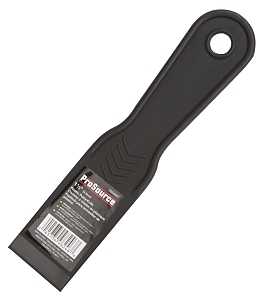
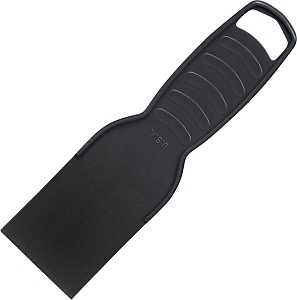
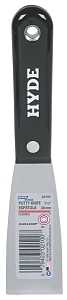
Three, most days. A one and a half inch stiff putty knife for scraping and spot filling, a six inch joint knife for bedding tape and the first coat, and a ten inch for the finish pass. Everything else on this page is a variation on those three.
Blade width by job
| Job | Blade width | What people grab here |
|---|---|---|
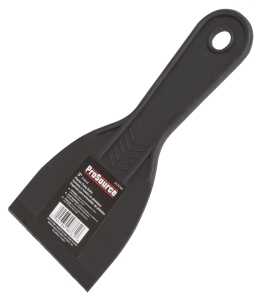
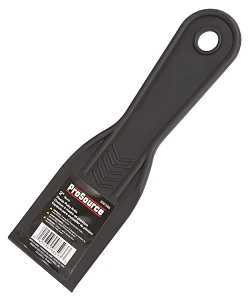
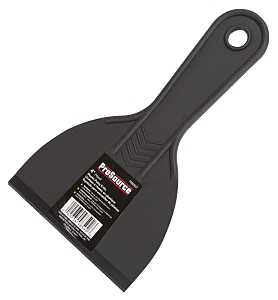
| Scraping loose paint, digging out a crack | 1-1/2 in stiff | Hyde Economy 05510, ProSource 1-1/2 in |
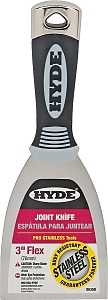
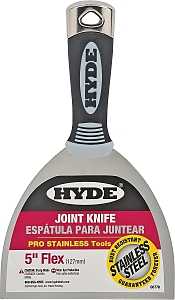
| Spot filling nail holes, glazing points | 1-1/2 to 2 in flexible | Hyde Pro Stainless 06108 |
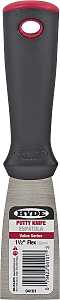
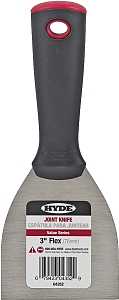
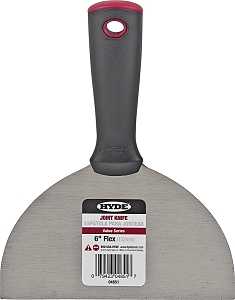
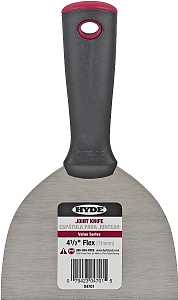
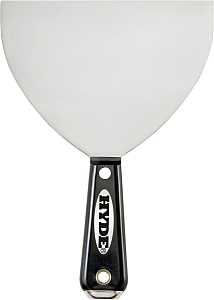
| Bedding tape, first coat over a seam | 6 in | Hyde Value 04851, Hyde 02870-6F |
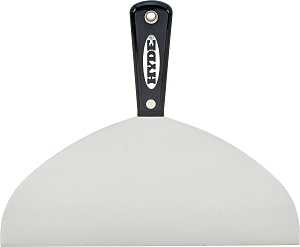
| Second coat, feathering the edge | 8 to 10 in | Hyde 02880 ten inch, Hyde 02990 eight inch flexible |
| Skim coating a whole wall | 12 to 14 in | Level5 5-138 fourteen inch |
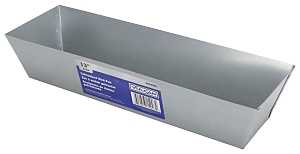
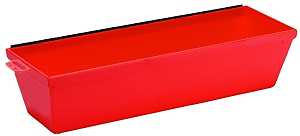
| Holding the mud while you work | Mud pan | Vulcan 15003, Marshalltown 914 |
Stiff or flexible
Stiff blades push. Use stiff for scraping, for prying a bad patch out, for pressing filler into a hole so it actually keys in. Flexible blades pull. Use flexible for spreading compound thin and leaving it flat, because the blade bends against the wall and rides the high spots down instead of digging in.
If you own one of each in a one and a half inch, you are covered for ninety percent of apartment work.
Plastic, carbon steel or stainless
Plastic is a dollar ninety nine and it is the right answer for scraping a radiator, opening a bucket, spreading adhesive, anything where you would rather throw the blade away than clean it. We sell a lot of these and nobody regrets them.
Carbon steel holds an edge and costs less than stainless. It will rust if you leave it wet in a bucket overnight. If you clean your tools, carbon is the value buy.
Stainless does not rust and it stays flat, which matters on a finish blade where a bent edge leaves a line in the wall. On anything six inches and up, buy stainless once instead of carbon twice.
Full tang, and why the handle matters
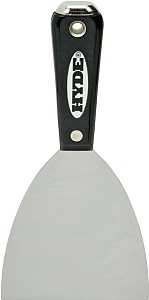
The tang is the part of the blade that runs back through the handle. Full tang means it runs all the way and is riveted. Those are the ones you can lean on and pry with. The Hyde Black and Silver and Pro Stainless lines are built that way. A cheap knife with a short tang will snap at the ferrule the first time you use it as a chisel, which everybody does eventually.
Do not forget the mud pan
A twelve or fourteen inch stainless mud pan with a hardened edge lets you clean the blade on the pan lip between passes. Working out of the compound bucket instead is how you get lumps in the finish coat, because the bucket edge is dried compound.
Buying for a building
Supers and painting crews usually buy the plastic scrapers by the handful and one good set of steel knives a year. If you are running several buildings, order the plastic in quantity and the stainless one size at a time as they wear.
Sign in to your First Ave account and the price on this page drops to your account price automatically. No code, no calling the counter. Guests see the register price, which is the same price you would pay standing in the store.
Shop this guide
20 itemsPrices shown are register prices. Sign in to see your account pricing.


More guides
- Which Steam Vent Do I NeedOne pipe steam, plain English, in about four minutes.4 min read

- What Ice Melt Does to Concrete, Floors and Your LiabilityWhy the cheapest rock salt costs a building more than it saves: spalling, ruined lobby floors, dead tree pits and slip and fall exposure.7 min read

- Safe Step Ice Melt, Which Bag for Which JobWhich Safe Step bag suits a sidewalk, a garage ramp, a roof or a pet area, with the working temperatures from the product data.4 min read

- Ice melt before the first freezeBuy it in October. Four minutes.4 min read

- NYC Trash Containerization Rules, and Which Bin You Actually NeedWho needs the Official NYC Bin, who can use any rigid 55 gallon container, set-out times, and what to buy for a 12 unit versus a 40 unit building.5 min read

- Can liners explained, which bag your building actually needsMatch liner dimensions, mil thickness and color to office cans, Brute containers, recycling stations, compactors and renovation debris.3 min read

- Which garbage bag do you use?Size by can, not by guess.4 min read
- Basement and closet lightingPorcelain keyless, pull chain sockets and the flush mount that replaces a bare bulb. The unglamorous fixtures that run a building.4 min read

- Batteries at the counterNine volts for smoke detectors, coin cells for the key fob, and why a building buys the sixteen pack.3 min read

- Drain daySlow, stopped, or the whole line. Three different problems.4 min read

- The turnover electrical kitWhat to buy once so the apartment is done in one trip.4 min read

- Toilet seats and bathroom turnoverRound or elongated, and the three numbers that decide it.3 min read

- Benjamin Moore at First AveAura, Regal Select, Advance, ben and Super Hide. Which line belongs on which wall, and which one a building actually buys.5 min read

- Paint prep, the painters kitEverything that goes in the bag before the paint does. Tape by surface, cloths by weight, grit by coat.4 min read

- Patch, fill and glueSpackle, joint compound, plaster of paris and the glue that actually holds. What to use on which hole.5 min read

- Roller liners and traysNap thickness by surface, liners by the sleeve, and why a metal tray outlives six plastic ones.4 min read

- Hang anything without calling the superPlaster, lath, brick or tile. The wall decides, not the hook.4 min read

- High security compared, Mul-T-Lock, Medeco, MarksWhat restricted actually means, and what a building is buying.5 min read

- Mops, brooms and the janitor closetWhat a porter actually uses every day, and the difference between a house broom and a lobby broom.4 min read

- Padlocks and lock boxesShackle size, keyed alike, and the lock box that lets a contractor in without you being there.4 min read

- The NYC pest kitGlue boards by the case, bait where it belongs, and the foam that ends the mouse problem for good.4 min read

- Window washingOne pass, top to bottom, wipe the blade. Why paper towels leave streaks and a squeegee never does.3 min read

- The odd bulb wallAppliance bulbs, night lights, circline, bi-pin and candelabra. The bulbs the big stores stopped carrying.4 min read

- Window guardsThe January notice, and what actually satisfies it.4 min read

- Birch or CDX, and Which Sheet Your Job Actually NeedsCDX by the sheet plus a cut charge, birch by the square foot, and the point where buying the whole sheet is cheaper than buying the cuts.6 min read

- Getting Sheetrock Into a Manhattan Walk-UpWhich board to buy, what fits the elevator, and what to have ready before the truck arrives at a walk-up.6 min read
- How Same-Day Delivery Actually WorksThe cutoff, the rates, and what happens when an order mixes shelf stock with next truck items.5 min read
- Gloves by the dozenNitrile by the box, coated knit by the pair, and what a building should keep in the closet.3 min read

- Scotch and 3M tapes by jobDuct, electrical, foil, thread seal and mounting. Which tape belongs on which job, and the three places people use the wrong one.4 min read
