
Guide
What Ice Melt Does to Concrete, Floors and Your Liability
Why the cheapest rock salt costs a building more than it saves: spalling, ruined lobby floors, dead tree pits and slip and fall exposure.
7 min read · First Ave Supply, 1587 First Avenue

Rock salt is the cheapest thing on the pallet and that is the whole reason it keeps getting bought. The material cost is not where a building loses money on ice. It loses money on spalled sidewalk slabs, on a lobby floor that has to be refinished a year early, on a dead tree pit the block association notices, and on one slip and fall. This is what the cheap bag actually costs.
Plain rock salt stops working before the cold does
Rock salt is sodium chloride. In theory it depresses the freezing point of water down to about minus 6 F. In practice, on a sidewalk, in wind, at the rate a porter actually spreads it, it stops doing useful work somewhere around 15 to 20 F. Below that the melting slows to nothing.
Here is the part that matters: it does not simply stop. Salt that has already made brine, then loses temperature, refreezes. You get a thin sheet of refrozen meltwater over a surface that looks treated. That is more dangerous than untreated snow, because it looks safe and it is not. Crews then spread more of the same product on top, which is money spent making the surface worse.
Freeze thaw damage and spalling on concrete
Salt does not eat concrete the way acid does. It damages concrete by driving water into it and then cycling that water through freezing. Brine holds liquid water in the pores of the slab at temperatures where plain water would already be ice. When the temperature drops far enough, that water freezes and expands, and it does it repeatedly across a winter. The surface layer pops off in flakes and patches. That is spalling.
New concrete is the most vulnerable. A slab under a year old has not fully cured and has an open pore structure, and it has usually not been sealed yet. If a building poured a new sidewalk, a new ramp or a new landing this year, treat it as a special case: use a blended or magnesium chloride product, spread lightly, and shovel first so the material has less work to do. Putting rock salt on a fresh pour is how a two year old sidewalk ends up looking twenty.
Lobby floors, carpet, elevator cabs and door tracks
Everything spread outside comes inside on boots. Brine tracked into a lobby is salt water with grit in it, and it goes exactly where it does the most damage.
- Stone and terrazzo: brine dulls the polish and leaves a white haze that returns every time the floor dries.
- Wood and vinyl: repeated wet and salt cycles lift finish and open seams.
- Carpet and walk-off mats: salt crystallizes in the pile, and the white bloom keeps coming back until the mats are extracted, not just vacuumed.
- Elevator cabs: brine sits in the door track and at the sill, which is where the corrosion starts and where door faults begin.
- Metal door tracks, thresholds and saddles: this is the fastest visible corrosion in the building.
The practical answer is matting and porters, not just product choice. Run enough walk-off matting to take three full strides inside the door, extract the mats rather than vacuuming them, and mop the sill area daily during a storm week. Choosing a blend with corrosion inhibitors reduces the metal damage. It does not remove the need to pick the brine up off the floor.
Runoff, tree pits and planting beds
On a Manhattan block the planted area is a tree pit six feet from the curb, and every gallon of meltwater from the sidewalk runs into it. Sodium in the soil damages root systems and shows up the following spring as leaf scorch, thin canopy and dieback on the street side of the tree. The tree does not die in January, it dies in June, which is why the cause usually goes unrecognized.
Keep spread material off the pit, do not pile salted snow into it, and use a magnesium chloride or blended product near plantings. Street trees are also a Parks Department matter in New York City, so damage to one is not only a landscaping expense.
Pets, paws and what pet safe actually means
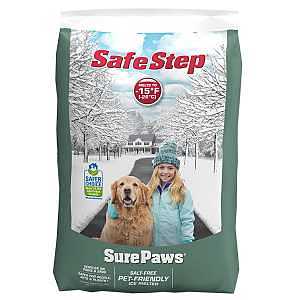
Pet safe is a marketing phrase, not a regulated standard. What the better products mean by it is real but limited: a rounded or less aggressive crystal that is gentler on paw pads, and a chemistry that is less irritating than coarse rock salt. Manufacturers word it as gentler on paws when used as directed, and that wording is deliberate.
What it does not mean: it is not non toxic, it is not safe to ingest, and it does not stop paw irritation if a dog walks through a heavy spread of it. Any ice melt eaten off the floor or licked off paws in quantity is a veterinary call. In a residential building the honest position to give tenants is that the product is chosen to be gentler on paws, that the dog should be wiped down at the door, and that the material should not be left in drifts on the walkway.
The liability angle, stated plainly
In New York City the property owner is responsible for clearing the sidewalk after a snowfall, on a clock, and a person injured on an untreated or badly treated sidewalk generally looks to the building. That is the exposure. One claim, with medical costs and legal costs behind it, is larger than a season of material for most buildings.
So the trade is simple. Under-treating to save a few hundred dollars on bags, or buying a product that quits at 18 F and leaves refrozen glaze, does not reduce risk, it moves the cost somewhere much more expensive. Keep a written log of when the crew treated and with what, because the log is what answers the question later.
We sell material, we do not give legal advice. Confirm your own obligations and your coverage with your counsel and your insurance carrier.
The blends compared
Ice melt chemistries compared
| Chemistry | Works to about | Easy on | Hard on |
|---|---|---|---|
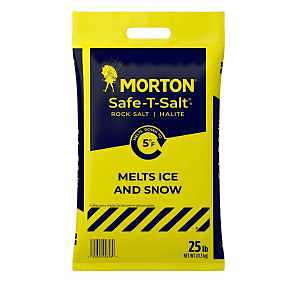
| Sodium chloride, plain rock salt | Useful work stops around 15 to 20 F | The budget, and nothing else | Concrete, metal, plantings, paws, floors |
| Calcium chloride | The coldest working chemistry in common use, well below zero | Speed. It pulls moisture and releases heat, so it cuts fast | Leaves a slick residue if over-applied, aggressive to metal, dries skin and paws |
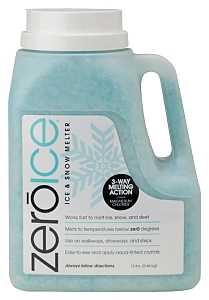
| Magnesium chloride | Rated to minus 15 F on the bags we stock | Concrete, vegetation and paws, relative to rock salt, used as directed | Costs more per bag, and it attracts moisture, so store it sealed and dry |
| Blends with inhibitors | Rated between minus 7 F and minus 15 F depending on the blend | The practical middle: cost close to salt, inhibitors gentler on concrete and metal | Still mostly salt by weight, so the housekeeping discipline does not change |
Working temperatures above are the ratings carried on the products we stock or the general behaviour of the chemistry. Bag coverage varies with spreader, crew and conditions, so we do not publish a square foot figure we cannot stand behind. Ask the counter what a building your size has been going through.
Buy the blend, not the cheapest bag.
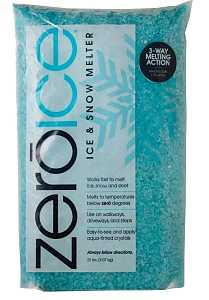
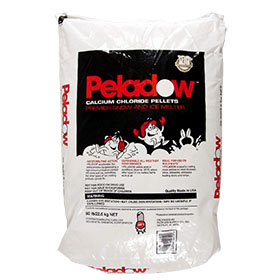
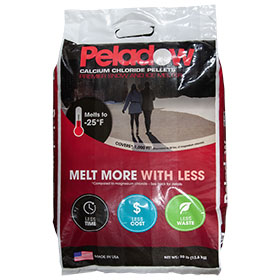
Here is what is on the shelf at 1587 First Avenue right now. For which bag suits which job, read Safe Step ice melt, which bag for which job.
Prices and stock are live. Same-day Manhattan delivery on what is on the shelf.
Price a preseason pallet for your building
Tell us roughly what you treat and we will come back with a pallet price and a blend that suits your sidewalk, before the first freeze empties the shelf.
Shop this guide
8 itemsPrices shown are register prices. Sign in to see your account pricing.
More guides
- Which Steam Vent Do I NeedOne pipe steam, plain English, in about four minutes.4 min read

- Safe Step Ice Melt, Which Bag for Which JobWhich Safe Step bag suits a sidewalk, a garage ramp, a roof or a pet area, with the working temperatures from the product data.4 min read

- Ice melt before the first freezeBuy it in October. Four minutes.4 min read

- NYC Trash Containerization Rules, and Which Bin You Actually NeedWho needs the Official NYC Bin, who can use any rigid 55 gallon container, set-out times, and what to buy for a 12 unit versus a 40 unit building.5 min read

- Can liners explained, which bag your building actually needsMatch liner dimensions, mil thickness and color to office cans, Brute containers, recycling stations, compactors and renovation debris.3 min read

- Which garbage bag do you use?Size by can, not by guess.4 min read
- Basement and closet lightingPorcelain keyless, pull chain sockets and the flush mount that replaces a bare bulb. The unglamorous fixtures that run a building.4 min read

- Batteries at the counterNine volts for smoke detectors, coin cells for the key fob, and why a building buys the sixteen pack.3 min read

- Drain daySlow, stopped, or the whole line. Three different problems.4 min read

- The turnover electrical kitWhat to buy once so the apartment is done in one trip.4 min read

- Toilet seats and bathroom turnoverRound or elongated, and the three numbers that decide it.3 min read

- Benjamin Moore at First AveAura, Regal Select, Advance, ben and Super Hide. Which line belongs on which wall, and which one a building actually buys.5 min read

- Paint prep, the painters kitEverything that goes in the bag before the paint does. Tape by surface, cloths by weight, grit by coat.4 min read

- Patch, fill and glueSpackle, joint compound, plaster of paris and the glue that actually holds. What to use on which hole.5 min read

- Roller liners and traysNap thickness by surface, liners by the sleeve, and why a metal tray outlives six plastic ones.4 min read

- Taping knivesWhich blade for which job, from the dollar plastic scraper to the fourteen inch skim blade.4 min read

- Hang anything without calling the superPlaster, lath, brick or tile. The wall decides, not the hook.4 min read

- High security compared, Mul-T-Lock, Medeco, MarksWhat restricted actually means, and what a building is buying.5 min read

- Mops, brooms and the janitor closetWhat a porter actually uses every day, and the difference between a house broom and a lobby broom.4 min read

- Padlocks and lock boxesShackle size, keyed alike, and the lock box that lets a contractor in without you being there.4 min read

- The NYC pest kitGlue boards by the case, bait where it belongs, and the foam that ends the mouse problem for good.4 min read

- Window washingOne pass, top to bottom, wipe the blade. Why paper towels leave streaks and a squeegee never does.3 min read

- The odd bulb wallAppliance bulbs, night lights, circline, bi-pin and candelabra. The bulbs the big stores stopped carrying.4 min read

- Window guardsThe January notice, and what actually satisfies it.4 min read

- Birch or CDX, and Which Sheet Your Job Actually NeedsCDX by the sheet plus a cut charge, birch by the square foot, and the point where buying the whole sheet is cheaper than buying the cuts.6 min read

- Getting Sheetrock Into a Manhattan Walk-UpWhich board to buy, what fits the elevator, and what to have ready before the truck arrives at a walk-up.6 min read
- How Same-Day Delivery Actually WorksThe cutoff, the rates, and what happens when an order mixes shelf stock with next truck items.5 min read
- Gloves by the dozenNitrile by the box, coated knit by the pair, and what a building should keep in the closet.3 min read

- Scotch and 3M tapes by jobDuct, electrical, foil, thread seal and mounting. Which tape belongs on which job, and the three places people use the wrong one.4 min read
